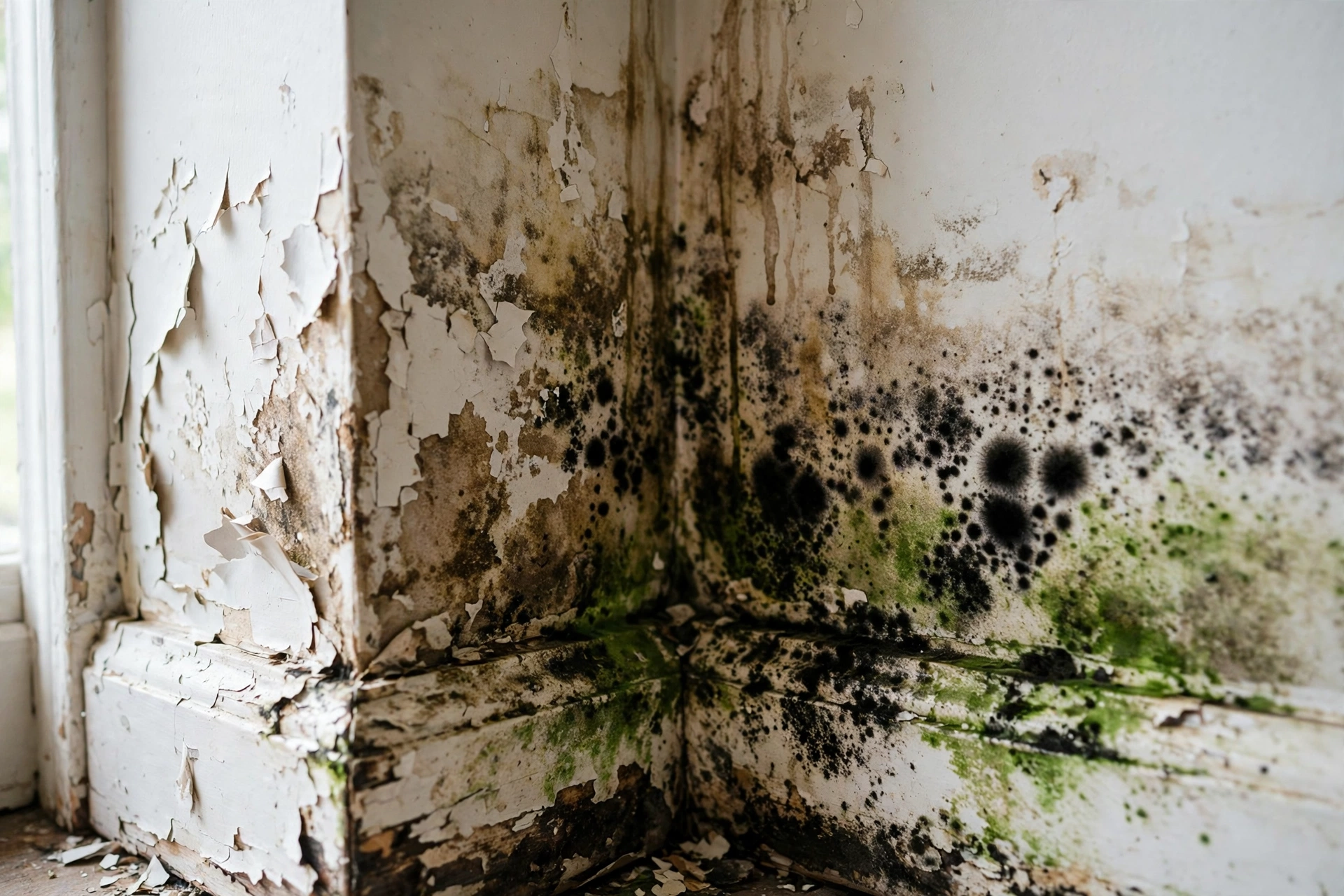
Black mold is the name people use for the dark green or black growth they find on soaked drywall, under flooring, and inside AC closets. The species behind most of the fear is Stachybotrys chartarum, and it grows where material stays wet for a long time: a slow leak, a flooded room that dried on the surface only, a condensate pan that overflowed for a season. If you have found it, the right response is calm and quick. Contain it, remove it, fix the water, and prove the air is normal again.
Gainesville FL Mold Removal removes it in Gainesville homes and rentals. Call us for an assessment.
What is black mold, exactly?
Stachybotrys is a slow growing mold that feeds on cellulose, the fiber in drywall paper, wood, and ceiling tile. It needs more water and more time than the common molds, which is why it shows up after long leaks rather than a single spill. It looks dark green to black and often slimy when active, dry and powdery when the water source stops. One honest point the CDC makes and we repeat: the color of a mold does not tell you how dangerous it is, and many dark molds are not Stachybotrys at all. Only a lab sample names the species, which is one reason testing exists. The fix, though, is the same for all of them: indoor growth comes out, and the water problem gets fixed.
How dangerous is it?
Here is the CDC’s position, without embroidery. Mold in a home can cause coughing, wheezing, and worsening asthma, and people with weak immune systems or chronic lung disease face a higher risk of lung infections. Claims beyond that, the dramatic lists you will read on scare sites, are not established science. What that means for your home: do not panic, and do not ignore it either. Keep people with asthma and small children out of the affected room, do not disturb the patch, and get it assessed. If someone at home is sick, that conversation belongs to a doctor, and our written report gives the doctor real information to work with.
Why bleach and scrubbing fail
Stachybotrys grows into the material, not just on it. The visible patch is the fruit; the growth runs through the drywall paper behind the paint. Bleach on a porous surface kills color at the top, adds water to the material, and leaves the roots in place. The patch fades, the photo looks better, and the colony is feeding again within weeks. This is why landlords who paint over mold end up in disputes, and why the EPA’s rule stands: porous material with mold growth comes out. Non porous surfaces like tile and metal can be cleaned. Soaked drywall, insulation, and carpet cannot be saved, and no spray changes that.
How we remove it, step by step
- Assessment and samples. A licensed assessor maps the spread, reads moisture in the walls around the patch, and samples when the species or the spread needs proof. You get a written scope and a firm price.
- Containment first. The area is sealed and put under negative air with a HEPA scrubber before anything is disturbed. These jobs are where containment matters most, because dry and powdery growth releases spores the moment it is touched.
- Material out, in bags. Affected drywall, insulation, and flooring are cut out, bagged inside the containment, and removed. Crews wear respirators and protective gear throughout.
- Treatment of what stays. Framing and solid surfaces are cleaned and treated. The water source, leak, condensate fault, or flood path, is fixed or scheduled with the right trade.
- Drying and clearance. The structure dries to normal readings. Then verification and air samples go to a lab. Normal results close the job, in writing. The full sequence is on our process page, and it is the same one used on our general remediation work.
How much does black mold removal cost in Gainesville?
The species does not set the price. The size, the material, and the water source do. Most of these jobs are the slow leak kind: a bathroom wall, an AC closet, a section of flooring. As a 2026 Florida guide, small contained jobs run $500 to $2,000, bathroom jobs $1,500 to $4,000, and AC closet jobs $3,000 to $8,000. The worked examples on our cost page show how those numbers are built.
Will it come back after removal?
The removed patch will not come back if the water is fixed and clearance passed. A new patch can grow anywhere a new leak keeps material wet, which in Gainesville means the prevention habits matter: keep indoor humidity between 30 and 50 percent, keep the AC condensate line clear, and fix small leaks the week you find them. Our homepage has the full prevention routine for Florida homes.
Found it? Do these three things now
- Keep the room closed and keep kids and anyone with asthma out of it
- Do not scrub it, spray it, or paint it: disturbing it spreads spores and ruins the assessment
- Call Gainesville FL Mold Removal for a licensed assessment and a written scope
Questions people ask us
Can I sleep in the house if it is growing in one room?
In most cases, yes, with that room closed off, until the job starts. If the growth is in the AC system, or a family member has asthma or immune problems, ask us and your doctor; the safe answer depends on your home, not on a rule of thumb.
How fast do I need to act?
Stachybotrys grows slowly, but the leak feeding it is damaging the home every day. Book the assessment within days, fix active water right away, and do not let anyone talk you into emergency pricing for a patch that has been there for months.
Does insurance cover it?
The same rules as any mold: often capped, commonly at $10,000, and usually only when a sudden covered event caused it. Our insurance guide explains the claim in order.
Sources: CDC, Mold Health (cdc.gov/mold-health) · US EPA, Mold (epa.gov/mold) · ANSI/IICRC S520 · Florida Statutes Chapter 468, Part XVI · Florida DBPR mold licensing